
RACE OFFICER PLATFORM INFO
The following are the Race Officer duties listed in sequence of actions
Before the Race
- Load the black R/C hard case, orange equipment box with keys, life preservers IAW Coast Guard regulation, and. DO NOT PLACE BINOCULARS IN BAG, BANGING THEM AROUND WILL BREAK THEM.
-
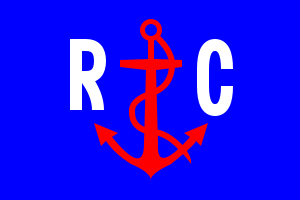 Display the BLUE
RC Flag (blue with RC on it) from
atop and POSTPONEMENT Flag before leaving marina.
(If proceeding to station at high speed, wait to fly RC and postponement flags until on station)
Display the BLUE
RC Flag (blue with RC on it) from
atop and POSTPONEMENT Flag before leaving marina.
(If proceeding to station at high speed, wait to fly RC and postponement flags until on station)
- For Centerboard Events: Leave dock in time to check wind and set marks of course, and anchor at starting line before 1700 start. Typically leave 1630.
- For PHRF Events:
- Leave dock in time to get to JB no later than 1630 to observe wind, pick course and starting line location.
- Go beyond the mouth of the creek and using the Wind Speed Meter, determine the wind speed and direction. Wind in mouth of the creek will be different than further out in the river. Pick a suitable course length for the wind speed and to get a windward leg using the course selection guide. Suggested Course Length is (Wind Speed Knots / 2). Courses are defined in Race Instructions Appendix D and the Course Selection Guide.
- Anchor such that the start line is approximately perpendicular to the course to the next mark. Ensure that the start line is at least 1 boat length (approximately 25 feet) long times the total number of starters for the race; longer is better. Do not anchor in the channel.
-
 Display the pure ORANGE flag
for Starting
Line on Race Officer platform.
Sight the start and finish line from this flag. For PHRF Events, display the course designation
for the racers.
Display the pure ORANGE flag
for Starting
Line on Race Officer platform.
Sight the start and finish line from this flag. For PHRF Events, display the course designation
for the racers.
- Get all required flags from the flag bag, White, P, Over Early, General Recall. Provide instructions and info to hailing competitors, log each as they check in. For PHRF events, announce course and approximate starting time of race on VHF 72. For Centerboard Events, announce course and approximate starting time of race to each competitor.
-
 Important Update:
Display the Postponement Flag (Answering Pennant) anytime a race is not yet started (and is
postponed). Do not display the Postponement Flag (AP) if the race has already started — use Race
Abandonded Flsg ("N" flag - a blue and white checkerboard flag) instead. Lower the AP, start the
clock, and sound the horn 1 time to notify racers that the Fleet Warning Signal (White Flag) is
in 1 minute. Announce "Start of Sequence in one minute" on VHF 72 (PHRF races) and via voice
(Centerboard races)
Important Update:
Display the Postponement Flag (Answering Pennant) anytime a race is not yet started (and is
postponed). Do not display the Postponement Flag (AP) if the race has already started — use Race
Abandonded Flsg ("N" flag - a blue and white checkerboard flag) instead. Lower the AP, start the
clock, and sound the horn 1 time to notify racers that the Fleet Warning Signal (White Flag) is
in 1 minute. Announce "Start of Sequence in one minute" on VHF 72 (PHRF races) and via voice
(Centerboard races)
- Do the starting sequence shown at the end of this section. It is suggested to use the count-up timer to minimize the math and potential for errors. However, record the time of day of the start of the sequence in case the count up timer fails or is accidentally reset.
- Monitor the starting line for boats that are over the line before the starting signal. If any boats
are over the line:
- All Boats Identified
-
 If any
part of any boat(s)
is over the start line when the start signal is made a second horn will be sounded and flag
"X" will be displayed. The Race Officer may hail the premature starter(s). When
all premature starter(s) have returned to behind the start line or after 4 minutes flag
"X" will be lowered. Competitors returning to restart have no rights over competitors
that have started. Announce competitors name(s)/sail number(s) on VHF 72.
If any
part of any boat(s)
is over the start line when the start signal is made a second horn will be sounded and flag
"X" will be displayed. The Race Officer may hail the premature starter(s). When
all premature starter(s) have returned to behind the start line or after 4 minutes flag
"X" will be lowered. Competitors returning to restart have no rights over competitors
that have started. Announce competitors name(s)/sail number(s) on VHF 72.
- Some Boats not Identified
-
 If the Race Officer cannot determine who is over early or
there is an error in the starting procedure, display the General Recall Flag
(First Substitute Flag - yellow triangle in blue triangle) and sound the horn
twice. The warning signal for a new start for the recalled fleet shall be made
one minute after General Recall Flag is lowered, and starts for any succeeding classes shall
follow the new start.
If the Race Officer cannot determine who is over early or
there is an error in the starting procedure, display the General Recall Flag
(First Substitute Flag - yellow triangle in blue triangle) and sound the horn
twice. The warning signal for a new start for the recalled fleet shall be made
one minute after General Recall Flag is lowered, and starts for any succeeding classes shall
follow the new start.
Important Update: Mid-Race Quick Decision Guide
Use this guide when conditions change during the race.
- Wind dropping / boats slowing: Consider Reduce Laps (Green Flag) if the lead boat has rounded the lap-finish mark. See "Reduce Number of Laps in Multi-Lap Course" in these instructions.
- Race too long but lead boat has not reached next mark: Consider Shorten Course (S Flag). See "Shorten Course" in these instructions.
- Dangerous weather (thunderstorm, fog, excessive wind): Consider Abandon (N Flag). See "Abandon Race" in these instructions.
- Boats still on course after most have finished: Use FIP (Finish in Place) or TLE (Time Limit Exceeded). See "Time Limit / FIP / TLE" section.
During the Race
- Important Update:
Record the clock time for the start of race (lowering of the White or Red Fleet Flag) on the
score sheet. Use this clock for all lap and finish times.
In addition, record the Time of Day when the Postponement Flag was lowered. Recording Time of Day is useful in case the clock fails or is accidentally stopped or reset. - Once all competitors have started:
- Important Update: Record the wind velocity on score sheet
- Important Update: Important Update: Record the Non-Spinnaker and Spinnaker courses on the score sheet
- For start/finish lines that are at a mark of the course, move to the finish mark to set a proper finish line as indicated on the course diagram. The finish line is a line between the finish mark and the ORANGE flag on the RO platform. The finish line should be perpendicular to the course from the prior mark.
- Record any lap times and finish times using the same clock that was used for starting sequence. The boat completes the lap or finishes when any part of Important Update: her hull crosses the finishing line from the course side, provided she has completed the course and is not continuing to sail it.
- Continuously monitor the conditions and if they deteriorate, consider the following options in order
presented. The intent is to
have a fair and safe race.
- Shorten Course
- If the lead competitors has not reached a mark, the race can be shortened to that
mark as follows:
 When appropriate, the Race Officer may shorten the course by
flying flag "S" (a white flag with a blue square in the
center). In this event, the Race Officer shall make every
effort to inform all competitors by using VHF CH 72, a two
sound signals and hailing. The finish line shall be a line
from the finishing mark perpendicular to the course from the prior mark.
The Race Officer platform shall be placed so that finishing competitors will
pass the mark on the original course side of the mark. The Race Officer can shorten the
course to
one of the designated marks for the course while the competitors are on that leg.
When appropriate, the Race Officer may shorten the course by
flying flag "S" (a white flag with a blue square in the
center). In this event, the Race Officer shall make every
effort to inform all competitors by using VHF CH 72, a two
sound signals and hailing. The finish line shall be a line
from the finishing mark perpendicular to the course from the prior mark.
The Race Officer platform shall be placed so that finishing competitors will
pass the mark on the original course side of the mark. The Race Officer can shorten the
course to
one of the designated marks for the course while the competitors are on that leg.
- Change of Course
- If the lead competitor has not reached a mark, the next mark or finish line can
be changed as follows:
The Race Officer may change a leg of the course that begins at a rounding mark by changing the position of the next mark (or the finishing line) and notifying all competitors on VHF CH 72, a single sound signal and hailing before any competitor begins the leg. The next mark need not be in position at that time.
- Reduce Number of Laps in Multi-Lap Course
- If the lead competitor has rounded the lap
finish mark, the number of laps for a multi-lap course can be reduced as follows:
When appropriate and prior to two competitors completing the original course, the Race Officer may reduce the number of laps in a multi-lap course to the last lap completed by the lead competitor by flying the pure GREEN flag. In this event, the Race Officer shall make every effort to inform all competitors by using VHF CH 72, two sound signal and hailing. The finish line shall be a line from the finishing mark perpendicular to the course from the prior mark. The latest lap times will be used as the official finish times. Competitors that have not completed the lap within time limit will be scored "DNF".
- Abandon Race
- The race needs to be abandoned if the following conditions exist:
- The conditions create a safety hazard, typically thunderstorm, fog, excessive wind.
- Two competitors have not finished prior to time limit of 19:00 during April, May, September, October or 19:30 during June, July, August. At the discretion of the Race Officer the time limit may be extended 15 minutes, typically for a freshening wind that has just about allowed the race to complete before the normal time limit.
When appropriate, the Race Officer may abandon the race by flying flag "N" (a blue and white checkerboard flag). In this event, the Race Officer shall make every effort to inform all competitors by using VHF CH6 72, three sound signal and hailing. When the race is abandoned, there will be no score for any competitor regardless of finish.
- Remain on station at the finish until all competitors have finished or have withdrawn from the race and released the Race Officer to return to shore. This is for competitor safety, Race Officer does not leave course until all boats return or boat indicates it is not returning and Race Officer is no longer responsible for safety.
- Time Limit
-
Important Update: Unless otherwise stated, the time limit for races during April, May, September, and October will be 1900. During June, July, and August the time limit will be 1930. If two or more competitors finish within the time limit, the race shall be valid for all competitors.
- At the discretion of the Race Officer the time limit may be extended 15 minutes. Important Update: Competitors finishing more than one hour after the time limit will receive a TLE (Time Limit Exceeded).
- Important Update: If the Race Officer and one or more competitors agree to be scored Finish in Place (FIP), mark each of the FIP competitors finish time as FIP.
- The Race Officer Platform is required to remain on station unless released by competitors remaining on the race course.
After the Race
Cleanup as follows:
- Put back the black RC hard case, orange equipment box with keys, life preservers, and put the Clock and Wind Meter back in protective box
- Roll up Course Board and put back in flag bag
- Put Flags back in flag bag
- Put back the Black R/C box, Horn, Radio, Binoculars, Flags back in Race Committee Locker
- Connect Horn and Radio to Battery Chargers
- Take photo of Score Sheet and email or text according to instruction on score sheet.